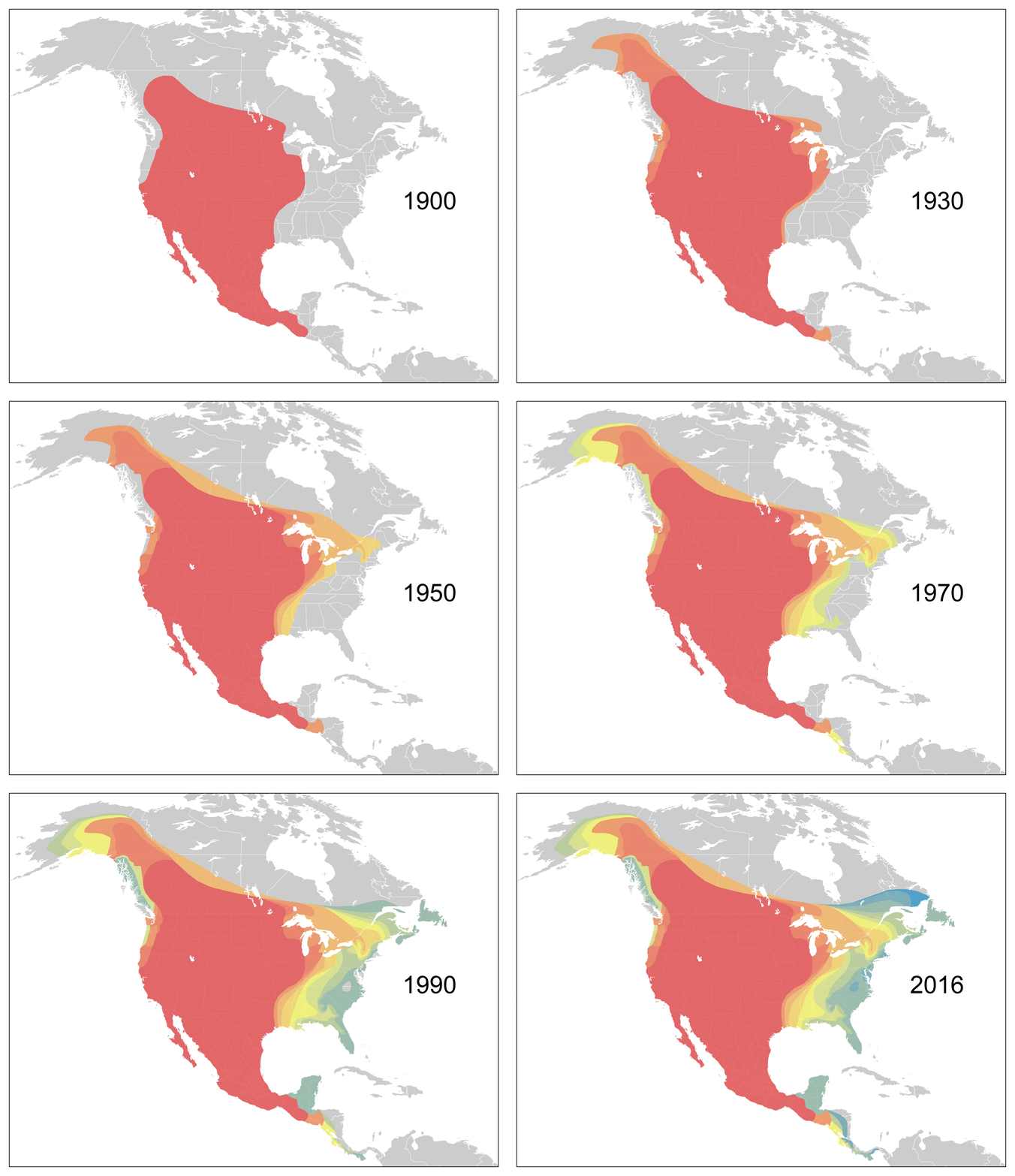
Source: North Carolina Museum of Natural Sciences, 5/22/18
I’ve spent the last three months observing Central Park’s first pair of Eastern Coyotes. It has been a wonderful experience. While coyotes are relatively new to Manhattan, they’re been living and breeding in the Bronx and Westchester for decades. Coyotes gradually made their way east of the Mississippi River over the last 100 years. Coyotes now live in most North America’s cities and have adapted well to urban and suburban life.
In Manhattan, we’re seeing the first few “pioneer” coyotes, but we should expect to have more as time progresses. I suspect we’ll have breeding coyotes in Manhattan by the end of the decade.
While watching the coyotes in May, I had a nice conversation with a person who has an apartment on Fifth Avenue but also a house in Greenwich. He asked me what I was doing, and I said I was watching a pair of coyotes. We talked about how some folks fear them and he said something that stuck with me. He said “In Greenwich when the coyotes first came, the town was in a panic. But soon folks simply learned to manage their garbage and keep their pets inside at night, so now they’re just part of everyday life and no one worries about them.”
In Manhattan, folks are often still in the panic stage. Public policy has improved, and people are starting to know they’re here, but the public is often still frightened by them unnecessarily. Although in Central Park, I now run into many people who are excited to share their own sightings.
While I got to know a coyote about fifteen years ago, until this April, the sightings I’ve had over the last few years had been infrequent. I saw the current male a few times on the North Meadow while watching the Snowy Owl in 2021. Since then, each year in the late winter and early spring when he’s sleeping on a ledge during the day, I’ve been able to watch him sleep and then wake up at dusk. However, I was never able to track of him after he ventured out of his daytime resting spot.
Last year, while watching a pair of Long-eared Owl, I got to see that the single coyote had become a pair. I had some great but very brief looks at them in the northern end of the park.
Except when the male coyote was sleeping, the sightings would be best called “glimpses”, and I only heard the coyotes howl once. This spring, aided by newly purchased thermal monocular, I have been able to spend many nights watching them and getting to know the pair. A handful of people had already been studying them for a few years, so I was a bit late to the party, but I quickly came up to speed.
Despite their reputation as being dangerous, coyotes generally do their best to stay under the radar in urban areas. This is the case with the pair of coyotes living in Central Park. They time their travels to avoid people and dogs, and they do their best to find areas of the park free of dogs and humans to sleep and relax during the day. To my knowledge there have been no reports of aggressive behavior towards humans or dogs by any coyote in Central Park, while there have been numerous dog attacks in Central Park. Park patrons and their pets are much more likely to be attacked by a domestic dog, than a coyote.
Urban coyotes can become aggressive if they lose their fear of humans, which is further worsened by people intentionally or unintentionally feeding coyotes. This could easily become an issue in Central Park due to the mismanagement of refuse by the restaurant concessions and the Conservancy, as well as the misguided feeding of wildlife, raccoons in particular. I write about this in a future post.
So, while my blog posts have been few and far between these last few months, I’ve been busy watching a fascinating pair of coyotes. The coyotes do their best to stay under the radar. They do their best to hide in plain sight and this pair unlike most coyotes are almost exclusively nocturnal. They’ve adapted to living in a crowded park. This flexibility is so much fun to study, just as I did with Red-tailed Hawks in small parks, such as Washington Square Park or Tompkins Square Park.
Over twenty years, I’ve had lots of great experiences watching a variety of species in Central Park at night including Bats (Eastern Red, Big Brown, Siver-haired and Tri-colored) and Owls (Eastern Screech, Barred, Barn, Long-eared, Great Horned, Snowy and a feral Eurasian Eagle-Owl).
(I tried to get into moths with Marie Winn and her friends, but it never captivated me. I think I’m too much of a behaviorist, and not enough of a taxonomist to enjoy them.)
Observing these coyotes has been like observing owls. As with owls, it is more involved than simply observing a species and how it is adapting to an urban environment. There are complications due to the news media and individuals exploiting the animals, lots of false rumors, incorrect interpretations of their behavior, and areas of public policy that need improvement.
Earlier this year there was a possibility the pair would have pups. They were seen copulating, but in May it was clear they weren’t going to have offspring this year. However, they might in later years, so I’m going to be cautious about what details I report and what I don’t. So, I’ll be writing about what they do, and will often leave out where and when they’re doing it.
So, I’m going to start doing weekly posts covering a range of coyote topics. Some will be lighthearted, and some will be more serious. I have a lots to share after watching the coyotes for three months.