Pale Male Eats A Rat

On Sunday morning, Pale Male waited patiently across from the Maintence Bathrooms and gently dropped 20 feet to catch a brown rat. He then ate the rat in about 8 minutes.

Rodents have overwhelmed the Ramble in Central Park this year, due to the careless overfeeding of birds, rodents and raccoons. The birds being fed are primarily non-native species of House Sparrows, Rock Pigeons and European Starlings and rodents, be are both Gray Squirrels and Brown Rats. I’ve been keeping track of those who feed birds in such a small area and I estimate that at over a gallons of seed, bread and peanuts is now thrown on the ground each day.

All of this food has created an environmental collapse of the Ramble. The rodents are competing against ground and cavity roosting and nesting native birds. And the non-native species of birds are also competing against our native species.

Using snare traps or non-invasive methods to kill the brown rats, such as dry ice, could be used safely but with all of the food being distributed in the Ramble, the rats will quickly return.

As my mother said, “God help us from do gooders”. The solution to this problem is going to be a tough battle, as those doing the feeding believe they are helping the birds. I hope the Central Park Conservancy along with the Urban Park Rangers and the Park Department’s Wildlife unit can work to educate the public.

Just adding for signage, along with educational materials would be helpful. Years ago, city parks had signs that said “Feed a Pigeon, Feed a Rat”. And in 2017, there was a campaign to discourage the feeding of wildlife. The wildlife unit should be encourage to expand their website to include a dedicated landing page about why feeding of wildlife isn’t appropriate, and signage should be expanded in Central Park with QR codes pointing park patrons to these website resources.

It needs to be noted that the bird feeding station in the Evodia Field managed with loving care by the artist, Frances Lee Rogers is not part of the rodent problem. These feeders are carefully designed to provide food during the colder season, for over wintering native birds, when natural foods are tougher to find. Birds flock to these feeders especially when snow or ice covers their natural foods and temperatures fall to extreme lows. These feeders are carefully managed to limit the amount of seed that falls onto the ground.

Late July, Early August

I’ve been birding on and off in the last two weeks, usually without a camera. It’s a quiet time with the first signs of fall migration just beginning. (I had two American Redstarts and a Northern Waterthrush yesterday.)

I have shot some snippets of what I’ve been seeing including:

  • Central Park’s resident Barred Owl who has stayed longer than anyone expected, about 10 months at this point.
  • The fledgling on Governor’s Island who is now a fantastic flier, exploring the island with ease.
  • Laughing Gulls on Central Park’s Reservoir. While they aren’t rare in the NYC area, it was a fun surprise to see them in the park.
  • One of the El Dorado Peregrine Hawks eating dinner.
  • Pale Male looking a bit scruffy, as he is molting.

End Of A 25 Year Run?

On Thursday morning, I checked in on Pale Male and Octavia to confirm that they weren’t nesting this year before I gave my lecture that evening, A Year With Pale Male, to benefit the New York City Audubon’s Science and Conservation Programs.

To all those who attended the lecture, thank you. The benefit generated much needed funding for NYC Audubon and I was also able to share what it’s like to watch and study an individual bird throughout the year. Pale Male is one of the easiest Red-tailed Hawks to study in North America, and he has allowed me to learn so much about his species.

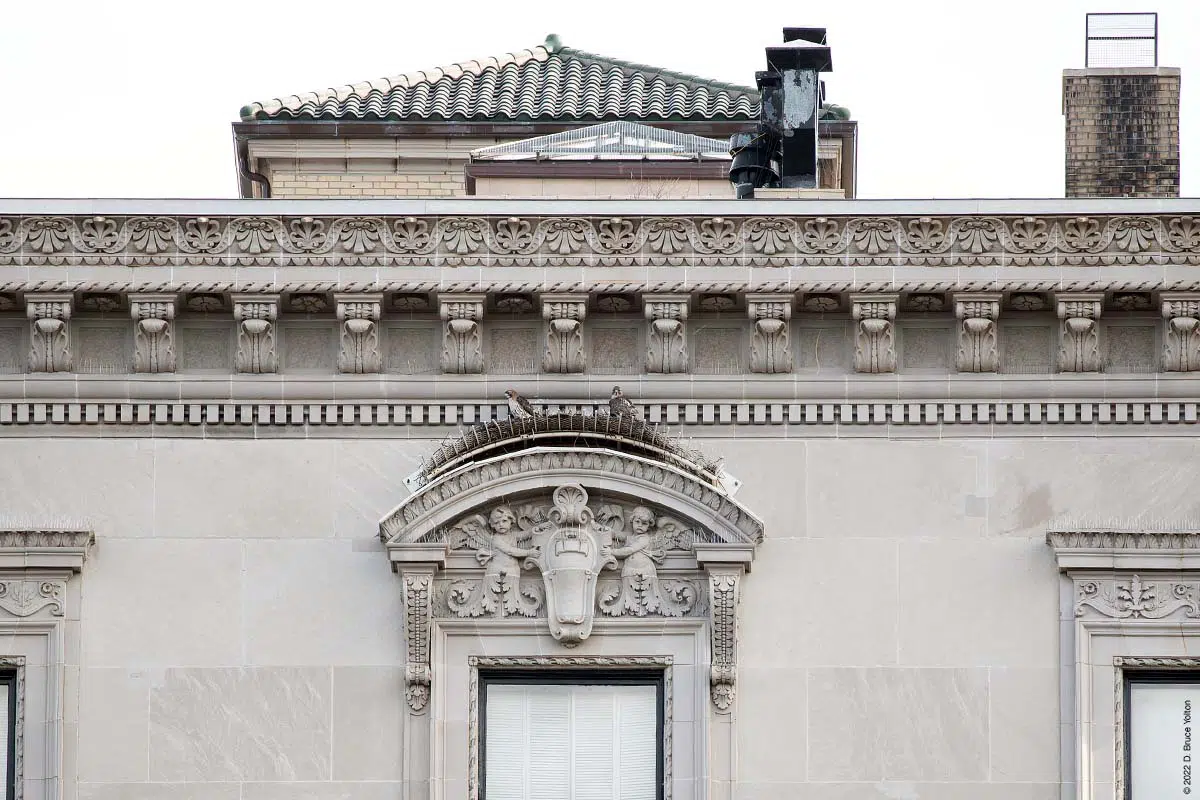
At the lecture, I reported the news that I had been hesitant to report until now, which is that it looks like the incredibly long run of nesting might be over at 927 Fifth Avenue. While Octavia has been seen standing on the nest for long periods each day with Pale Male perched on nearby building, she clearly isn’t sitting on eggs and the nest seems to be in disrepair. Ordinarily, Octavia would have been brooding for at least three weeks at this point in the season.

They could just be late this year, but it is doubtful. For the last two years, Octavia brooded without success. So, it looks like we’re entering a new chapter in the life of Pale Male and Octavia. I look forward to observing this new stage in Pale Male’s life.

Pale Male and Octavia

I visited all three Fifth Avenue nests on Saturday. Thomas Cardinal Cooke looked fine and I saw one exchange (hawks switching egg warming duties) and saw the female on the 1115 Fifth Avenue nest.

The nicest thing I saw was Octavia on the nest and Pale Male on the “Linda” building. They both looked great and based on Octavia’s behavior on the nest, she may soon be laying eggs.

I’m giving a lecture about Pale Male and his family on April 8th to benefit NYC Audubon. More details are on their new website, here. NYC Audubon has done some so much to support Pale Male over the years, I hope you join me.

Octavia and Pale Male

I’ve been so wrapped up with owls this winter that I haven’t been doing much hawk watching. Today, I was in the right place at the right time and saw Octavia on the 927 Fifth Avenue nest and Pale Male in the Ramble.

Unlike last year, I should be able to get around the city to check on nests this year. We have some mysteries to solve, such as if the male at Washington Square Park is the 2nd or 3rd hawk of the nest and get to know the new female. There is also the Fort Tryon nest I never got to see.

Hopefully, 2021 will be a good year for hawks in Manhattan.