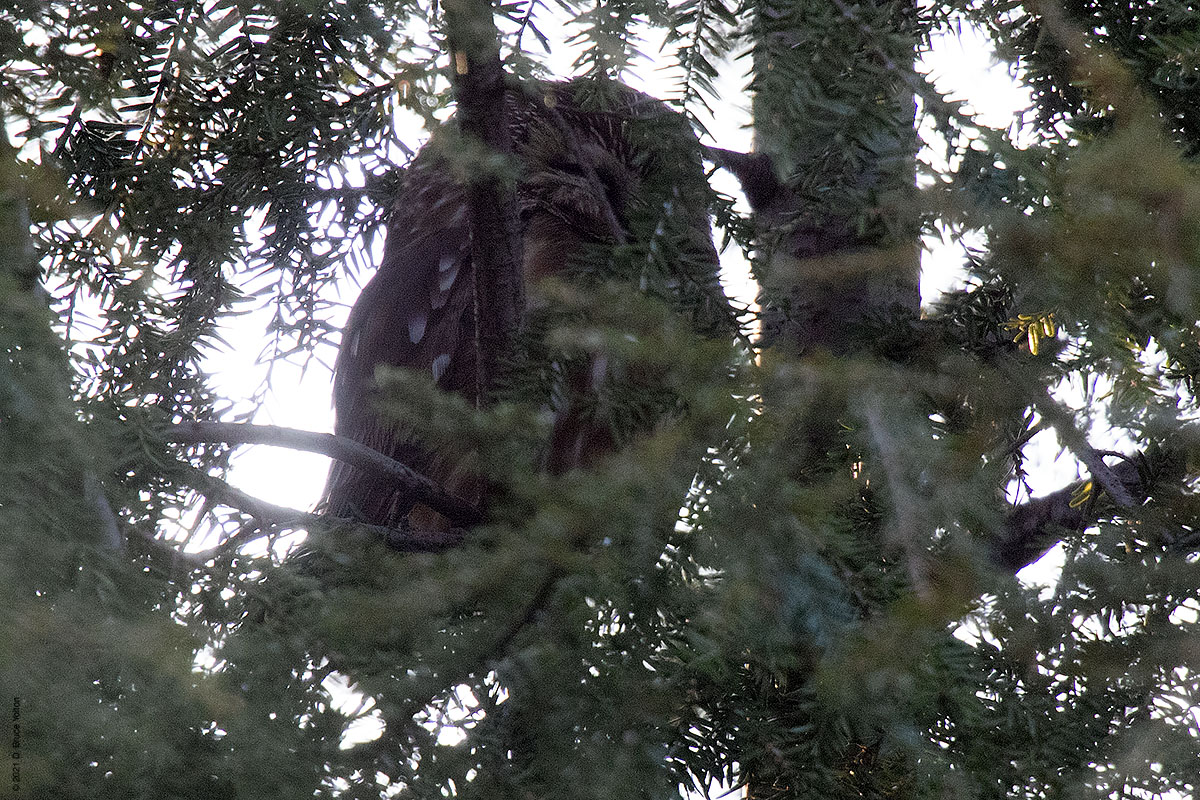
El Dorado Peregrine Falcons

The single Peregrine Falcon that I saw for most of the winter has been seen with a mate for a few weeks. I’ve had two friends tell me the news, and I saw what was most likely this pair flying around the Annenburg Building of Mount Sinai but this was the first time I saw them perched.

One was at the base of the top most portion of the North Tower, and one was on the AC unit they like to use to eat.

Cardinal Cooke Red-tailed Hawk Nest

Over the last few weeks, a pair of Red-tailed Hawks has been building a nest on the Terence Cardinal Cooke Health Care Center at 1249 Fifth Avenue at 106th Street. It’s on a ledge near the top of the building on the southwest corner. It overlooks the Conservatory Garden of Central Park.

I never give this location my attention, since hawks have built here in the past only to have the nest blow away.

So, I was very, very surprised to see an exchange (when one hawk relieves another hawk of egg sitting duties) today. I’ll have to go back to make sure but everything looked like it was an active nest.

Backtops and Infields

Tonight the Snowy Owl arrived at the Compost Heap, but due to the high winds, aborted her landing and when directly to the eastern side of the North Meadow. It was backstop, ground, backstop, backstop, backstop, hunt, eat for a very long time, then some play in a few puddles. Then a puddle in the home team dugout before going out to 1st Base, and then we lost track of her. Similar to when she arrived, she used the infield sand right next to grass.

She took at least an hour to eat the first half of the Brown Rat, but then ate the second half in a few seconds.

She was done hunting and eating her first rat by 9:00 pm. Usually we would have looked for where she went after eating, but it was just too cold with high winds and dropping temperatures, so most of us went home.

Hunting In Plain Sight

Tonight, the Snowy Owl appeared in her regular perch, but stayed in the trees of the Compost Heap for over two hours. I was able to get dinner and return before she left!

She then went to backstop #11 and stayed for about 30 minutes before hunting a Brown Rat almost right in front of us on a park path that leads to the Recreation Center. I heard the rat cry as it was killed.

She stayed on the ground for a few minutes before flying to the infield of ball field 10. I thought there was snow, but it was water on the ground. She took her time eating and finally finished by eating a large piece whole around 11:45. She didn’t do as much cleaning and playing in the grass as she had in the snow, but she did do some before flying off.

Another Eastern Coyote Sighting

While watching the Snowy Owl in Central Park, we saw the Eastern Coyote again. Something unsettled all of the Canada Geese that were on the east side of the North Meadow, and that caused the Snowy Owl to move to the western side. As we followed her as she flew, we saw the Eastern Coyote.

The Eastern Coyote moved north and then jumped the fence. I caught up with it again and the western side of the North Meadow behind field 3.

I thought it was special to have a sighting last week, but having another so soon was just fantastic.

Change Up

The Snowy Owl is very good at adjusting her schedule to avoid people and dogs. She did this tonight by avoiding the Compost Heap area, which has had crowds the last few nights by going directly to the ballfields.

Owl watching takes patience, and an understanding that it might take a few visits to see the owl you’re looking for. It also requires you to take the time to figure out how not to disturb the owl, and can require a commitment of three to four hours for a few nights in a row. Last night, those who were patient, and had learned her habits watched her for over two hours, quietly from a safe distance. She only moved after the Eastern Coyote arrived.

The Manhattan Bird Alert is promoting this owl as an easy thing to go see. On a few nights she has been, but in reality she can be hard to find, and more importantly, it takes effort to watch her without bothering her.

This Snowy Owl is much more difficult to observe than other owls because you can’t see her fly out of roost like you can with a Barred Owl or Great Horned Owl. Watching her isn’t about just showing up at a specific time, at a specific tree.

Ethical Field Practices sign at Jones Beach

Bird watching isn’t Pokémon Go. It isn’t about running after something, seeing it, and moving on to the next species. This relatively new Twitter based phenomenon of running after sightings is the equivalent of fast food. Lots of empty calories. One of the great joys of bird watching is observing a species and learning what makes it unique. You can’t do that if you’re rushing around directed by Twitter.

I was sent a sign that is posted near a Snowy Owl location at Jones Beach by Jeff Kraus, created by the North American Nature Photography Association (nanpa.org). It’s recommendations apply to Central Park as well.

It’s possible to observe this owl, while still letting her hunt, eat and live with minimal interference.