Inwood Hill Park

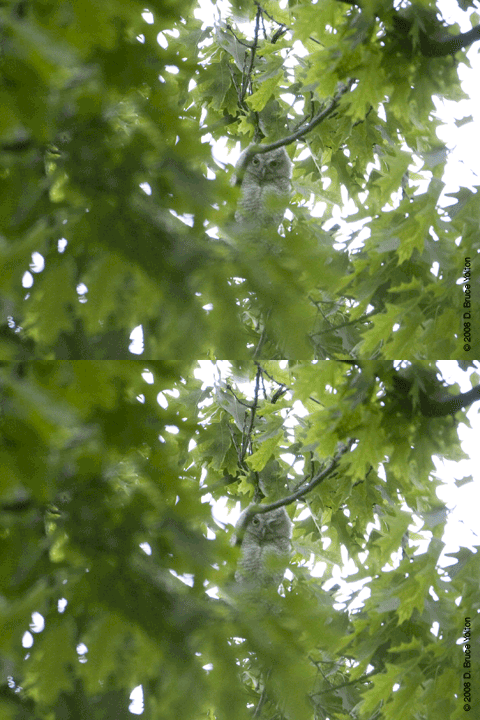
The nest is now very difficult to view due to leaf cover.  I tried to get pictures from at least six angles and just got lots of green!  I saw at least four visits from the adults, so I suspect all is well.  The Inwood Hill Urban Rangers report seeing two chicks.

I did get to take a series of pictures of one of the adults over a soccer field.

052408ihp01
052408ihp02
052408ihp04
052408ihp05

St. John the Divine

This season has had its problems up at St. John the Divine.  The male of the pair died and was replaced by a younger hawk, and there has been repair work on the roof right by the nest.

Unlike many of the other New York City nests, we can’t see the eyasses until they are about two weeks old due to the height of the nest.  So, with a new father and construction, there were lots of worries that we hadn’t seen anything yet.

So, it was with great joy that the eyasses were finally sighted over the last few days by Robert and Lincoln.

I had gone up on Thursday and didn’t see them but was rewarded on Saturday morning.  There appear to be two eyasses.

052408sjtd01
052408sjtd02
052408sjtd03
052408sjtd04
052408sjtd05
052408sjtd06
052408sjtd07
052408sjtd08
052408sjtd09
052408sjtd10
052408sjtd11
052408sjtd12
052408sjtd13
052408sjtd14

Unisphere 2008

Thanks to a text message from Lincoln Karim, I went out to the Unisphere in Flushing Meadows, Queens and was able to find the new Red-tailed Hawk nest location.  It is about minus 30 degrees of longitude from the old nest.  Instead of being near Indonesia, it is now in the Indian Ocean off the coast of Somalia.

I had received reports earlier in the season that the nest site was empty.  The nest is in an I-beam, so it must be easy for the mother to hide while brooding and for the eyasses to hide when they are young.

There are at least two chicks in the nest.  In the pictures that follow, the mother captures, eats and feeds a young pigeon to her eyasses.  Readers beware.

The Unisphere
On the left, East Africa, the nest is in the center, and the adult female is on the right.
The adult female perches on a light around the perimeter of the Unisphere plaza.
The adult female hunts at the bottom of the Unisphere. 
There are a number of nesting pigeons, and she grabs a juvenile pigeon.
After eating a great deal, she takes a piece to the nest after a few stops to gain altitude.
Landing on the nest.
My first sighting of an eyas.
Two eyasses
Two young heads
The adult female on Cuba.

Wednesday, 5-14-08

It was an interesting evening.  The owls stayed high in the tree tops.  They went to the drive and seemed to be eating something in the tree tops.  They also when across the drive and back.  I’m afraid we’ll soon be losing track of this family.

051408eso01
051408eso02
051408eso03
051408eso04
051408eso05
051408eso06
051408eso07
051408eso08
051408eso09
051408eso10
051408eso11
051408eso12
051408eso13
051408eso14
051408eso15
051408eso16
051408eso17
051408eso18
051408eso19
051408eso20
051408eso21
051408eso22
051408eso23
051408eso24

Astoria/Triborough Bridge Nest Moves North

The Astoria/Triborough Bridge nest has at least two chicks in its new location on the other side of the bridge.  (Thanks, Jules Corkery for the update.)  I didn’t get great pictures this evening but wanted to share them never the less.

The Astoria female was very ill this fall and was nursed back to health under the care of Bobby Hovarth.  With all of the bad news, it’s important to remember that there are still lots of positive stories and successes in New York City.

Update 5/15/08: Also on the good news front Peregrine Falcons are doing well this season.  55 Water St. has a scrape with four nestlings which can be viewed on a webcam, and at least two birds have fledged on the Met Life building.

051408as01
051408as02
051408as03
051408as04
051408as05
051408as07
051408as08
051408as09